
Exploring the Terroir of Burgundy
"Why are Burgundy wines so special?"
If you love wine, you've probably wondered this at least once.
The answer lies in the concept of "terroir." In this article, we'll explain the secrets of Burgundy's terroir in an easy-to-understand way.
What Exactly Is "Terroir"?
The "Character of the Land" Composed of 3 Elements
Terroir comes from the French word for "land," but it's much more than just land.
It refers to "the unique character that can only be born in that specific place" - a combination of these three elements:
| Element | Description | Burgundy's Features |
|---|---|---|
| Soil | Minerals absorbed by vine roots | Complex layers of limestone, clay, and marl |
| Climate | Sunlight, temperature, rainfall | Cool climate with significant year-to-year variation |
| Topography | Elevation, slope, orientation | Gentle hillsides. East to south-facing slopes |
Key Point Terroir also includes human hands (traditional cultivation and winemaking techniques). Nature and human effort combine to create the wine's character.
What Makes Burgundy Special?
"The Vineyard Next Door Tastes Different" - Remarkable Diversity
In Burgundy, wines can taste completely different from vineyards just a few meters apart.
This is a phenomenon found nowhere else in the world.
| Comparison | Burgundy | Other Regions |
|---|---|---|
| Grape varieties used | Pinot Noir/Chardonnay only | Often blend multiple varieties |
| Taste determinant | Vineyard character (terroir) | Winemaking techniques and blends have major impact |
| Vineyard divisions | Extremely detailed (hundreds of meters) | Managed in relatively large plots |
Why Single Variety?
In Burgundy, red wines are made from Pinot Noir and white wines from Chardonnay - single varieties.
The reason is clear:
"To express the differences in terroir in the purest way possible"
Blending multiple varieties would blur the individuality of each vineyard. Using a single variety allows the land's character to come through directly in the taste.
Understanding Burgundy's Classification System
The 4-Tier Pyramid
Burgundy wines are divided into four levels based on quality and vineyard classification.
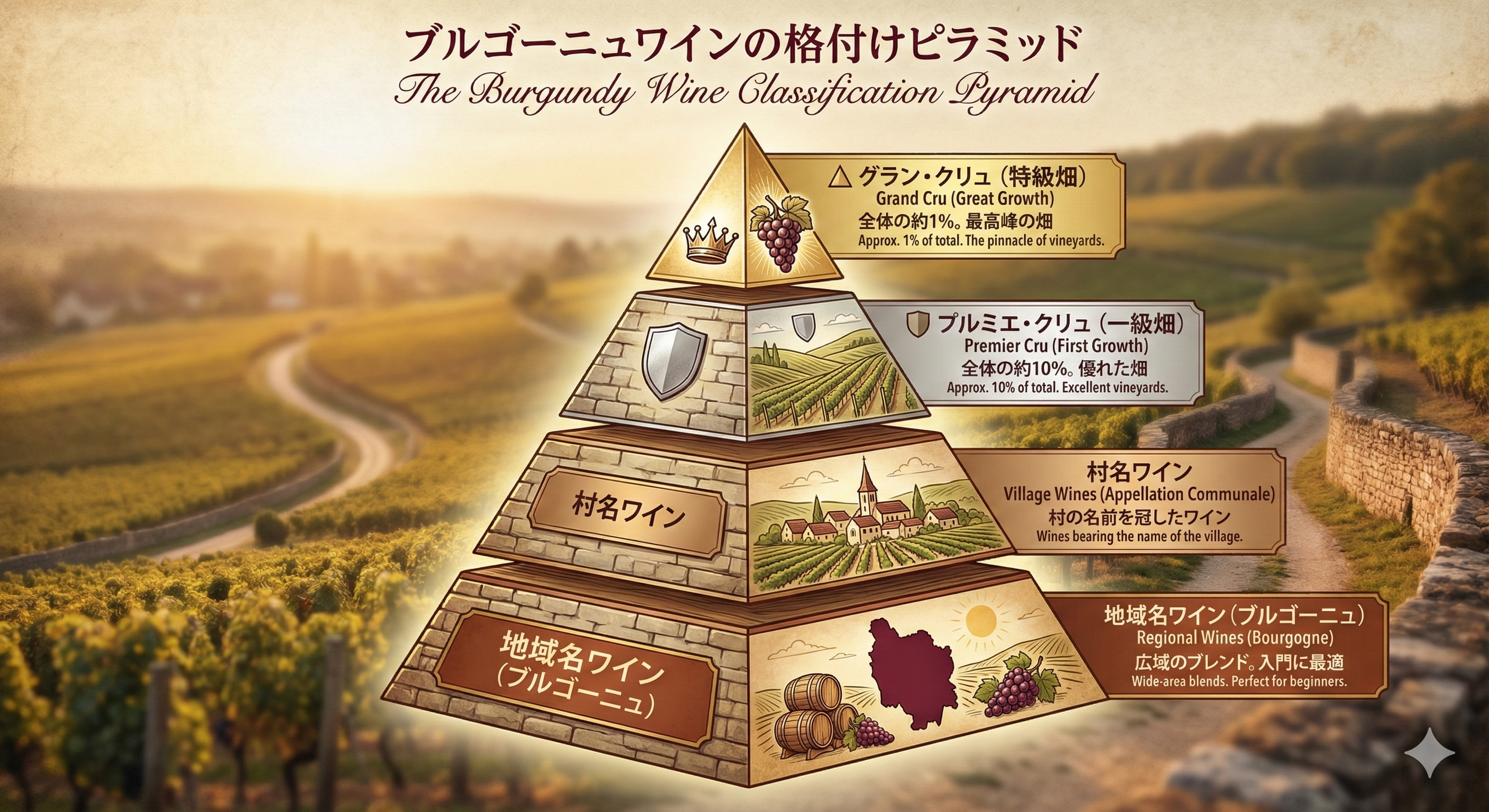
| Level | Example Label | Characteristics |
|---|---|---|
| Grand Cru | Romanée-Conti | Best plots. Suitable for long aging |
| Premier Cru | Gevrey-Chambertin 1er Cru | Excellent plots. Well-balanced |
| Village | Gevrey-Chambertin | Enjoy the village's character |
| Regional | Bourgogne Rouge | Perfect for beginners |
Famous Vineyards (Climats) to Know
Legendary Vineyards to Experience at Least Once
In Burgundy, vineyards are called "Climats." In 2015, Burgundy's Climats were registered as a UNESCO World Heritage Site.
| Climat Name | Characteristics | Episode |
|---|---|---|
| Romanée-Conti | A tiny 1.8-hectare vineyard | World's finest Pinot Noir. Only a few thousand bottles per year |
| Montrachet | The pinnacle of white wine | So revered it's said "drink it on your knees" |
| Chambertin | Powerful and complex red | The vineyard Napoleon loved his entire life |
| Clos de Vougeot | Large Grand Cru at 50 hectares | Divided among approximately 80 producers |
Steps to Enjoy Burgundy
From Beginner to Expert - Progressing Step by Step
By advancing through stages, you can understand its depth.
| Step | Recommended Wine | What You'll Learn |
|---|---|---|
| Step 1 | Bourgogne Rouge | Basic character of Pinot Noir |
| Step 2 | Village wines | Differences between villages |
| Step 3 | Premier Cru | Vineyard character, aging enjoyment |
| Step 4 | Grand Cru | The essence of terroir |
Understanding Village Characteristics: Recommended Comparisons
Comparing wines from different villages at the same level helps you experience the differences in terroir.
| Village | Taste Profile |
|---|---|
| Gevrey-Chambertin | Powerful, solid structure |
| Chambolle-Musigny | Delicate and elegant |
| Vosne-Romanée | Floral and complex |
| Pommard | Rich, tannic |
The Legacy of the Monks
"Vineyard Wisdom" Born from 800 Years of History
Burgundy winemaking traces back to medieval Cistercian monks.
Their legacy includes:
- Vineyard boundaries - Observed taste differences and identified optimal plots
- Cultivation techniques - Records of trials and errors across generations
- Winemaking philosophy - The idea of "maximizing the land's character"
Modern producers inherit this 800-year legacy while striving for even greater heights.
Summary: Key Points for Understanding Burgundy
| Point | Description |
|---|---|
| Terroir | The "land's character" created by soil, climate, topography, and human hands |
| Single variety | Expressing the land through Pinot Noir/Chardonnay |
| Classification system | Regional → Village → Premier Cru → Grand Cru |
| Vineyards (Climats) | Diversity where taste changes within meters |
| History | 800 years of monastic legacy |
At our restaurant, we offer a variety of Burgundy wines.
Even if you feel "Burgundy seems difficult," please don't hesitate to ask. Our sommelier will carefully guide your journey into Burgundy.